Film Talk · In Conversation
The Scenery Left Behind
A Foggy Tale — Commemorative Box Set Launch Talk
目錄
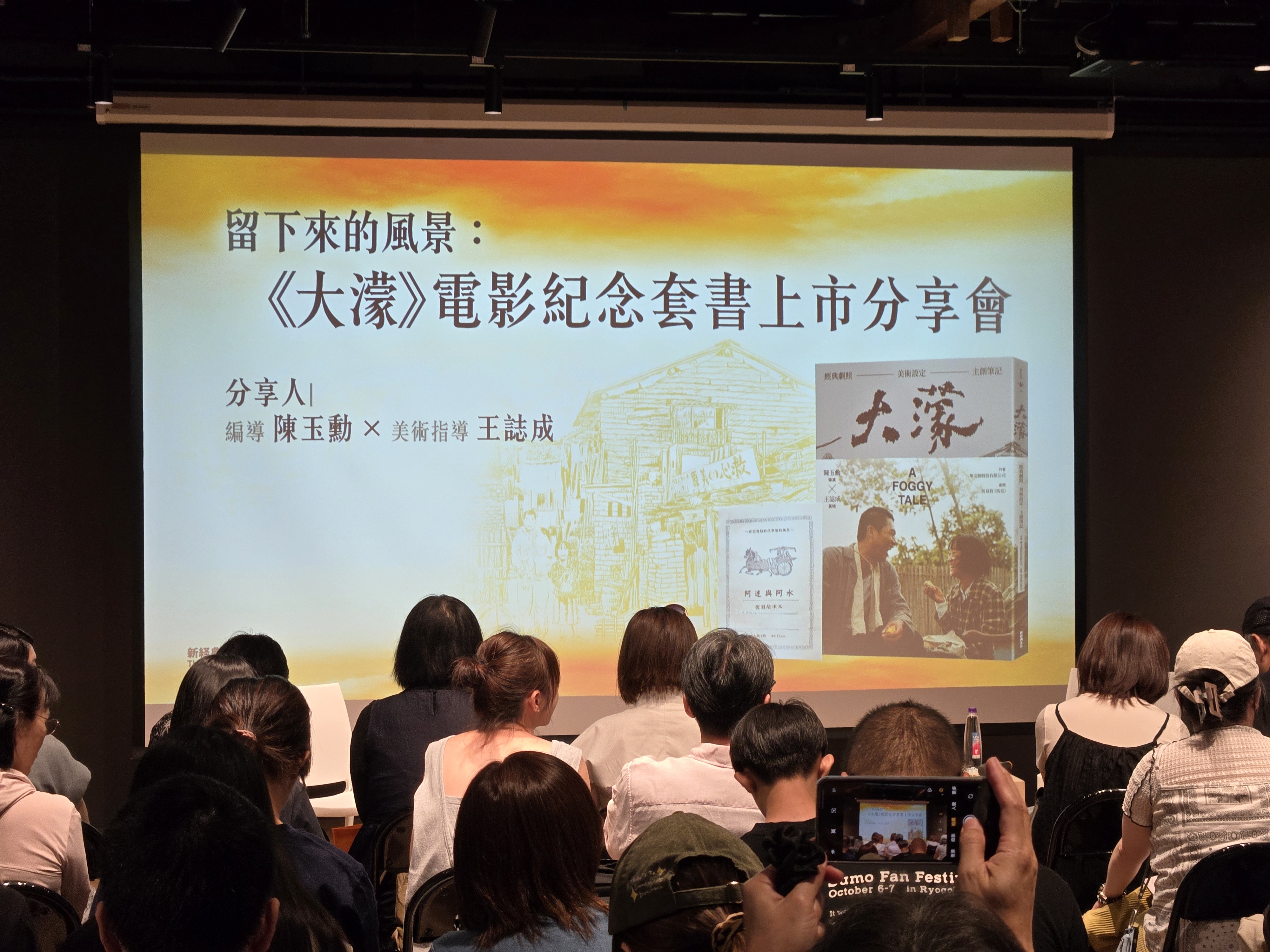
The talk is built around eight slide questions — from where the script and the production design each began, through casting, the hardest scene to shoot, the most moving moment, and finally to why the book was made. The two on stage — writer-director Chen Yu-hsun and production designer Wang Chih-cheng — met more than twenty years ago: when Chen took Tropical Fish (1995) to Japan to promote it, Wang was the Taiwanese exchange student hired as interpreter. Later, doing commercials, Chen found Wang was already an art director; they have worked together ever since.
Commercials and films put Chen in completely different moods: commercials mean serving clients and their many opinions — anxious, irritable work; a film leaves him "never quite full," because he writes the script himself and has no one else to blame. There is tension between director and designer, too — Chen insisted the lead Chao Kung-tao's room be tiny and destitute, while Wang quietly tried to make the space bigger, even sneaking in a bed for a "roommate," which Chen vetoed: "There's no roommate in the script — are you trying to overturn the whole setup?" It became a snapshot of how the two get along day to day.
Where did the script and the production design each begin?
"Every time I finish a film I have to start imagining the next one." As he grew older, he became curious about his mother's generation (Japanese rule → retrocession → the White Terror), and began digging into 1950s material — the more he read, the more it shook him. He found that in the 38 years since martial law was lifted, fewer than ten films had been made about the White Terror, and felt this was a subject that had to be filmed.
He read widely and consulted advisers, coming to understand that the White Terror can't be seen from a single angle — among the victims were real communists, underground party members, and the wholly innocent. He deliberately chose a little girl's point of view, because a more brutal version was one he couldn't bear to shoot and audiences couldn't bear to watch; the whole film took about four years from writing to release, and for those two years he was sunk in that emotion, tearing up even at the editing table.
The final choice was deliberate restraint: no standard answers, hoping viewers would go home and verify the history themselves — which he believes is exactly why the film still sparks such heated discussion.
「I have no right to speak for them; I only want to stand beside them and keep them company.」
—— Chen Yu-hsun
How were the four leads cast?
First, the producing team (nicknamed "the Empress Dowager," with Chen calling himself "the little emperor") — he has worked with producers Li Lieh and Yeh Ju-fen for over a decade, with composer Lu Luming a long-standing support in creative and casting decisions; the team's shared trait is being "gentle and calm," and in 20-some years Wang has never seen Chen lose his temper. The four leads:
He had her in mind while writing (he admired American Girl, her eyes carry feeling). Her Mandarin wasn't strong, so he trusted instinct; she's a natural at Taiwanese, picking it up instantly.
He noticed her years ago singing on stage at a wedding; round-faced, with a Taiwanese warmth. She didn't speak Taiwanese, so a teacher was brought in.
He spotted him in Drifting while judging a competition. A Hong Konger with no Cantonese accent and standard Mandarin — Chen briefly thought he'd "got it wrong," but trusted instinct and the actor drilled his way through.
He thought of him while writing, and confirmed it after discussing with the producers.
How did the art team bring the storybook to life?
The hand-drawn storybook in the film, A-shui and A-mi, is a keepsake the brother gives his sister. It echoes the script's core parable of "two drops of water" — one longing to become clouds and rain to nourish the land, the other unable to, dissolving into fog (also the origin of the title, "A Foggy Tale"); the letter Yu-yun writes home from prison uses this same parable.
The hard part was that "you understand it on paper, but turning it into a real prop" is brutal. The characters are dirt-poor, so only what's at hand could be used — sweet-potato rice, yams, ash and charcoal as pigment — letting the prop's poverty match the characters' circumstances. Wang first drew a proposal himself; the director found it "too cute," so he set the whole art team the task of drawing it, and the chosen version came from an intern, revised many times before it was finalized.
What was the hardest scene to shoot?
The one that stayed with him was the formalin pool (the autopsy scene). The art team referenced material from the National Defense Medical Center plus historical photos of U.S. medical teams, settling the architectural language as Japanese-style. The body was a custom mannequin (very expensive, NT$70–90k), hooked with a bamboo pole to avoid jabbing the actors — discussed many times; the water was warmed (shot in December, to keep actors from hypothermia).
Before rolling, he told the crew "don't get too excited." That day everyone was unusually quiet, fog even rose on set (rare on the Chianan Plain), the mood solemn — everyone felt "the martyrs were somehow there beside us." What he was least sure of wasn't technique but performance: Fang Yu-ting was only seventeen or eighteen. In the end, "every take was identical to the last, unbelievably strong" — after two takes the director relaxed, thinking "this film should work."
The most moving moment?
At every post-screening Q&A after release, seeing the house full, no one leaving, everyone applauding — "this is what the audience gave us; it is, truly, such happiness." He often slips to the side of the room just to hear the applause.
The sugarcane-field scene on the first day of shooting; and, watching the finished film, the gap between "seeing it live" on set and what the director cut together. He also spoke of the closing still marked with a Republic-era year, and why it carries such force — viewers project their own experiences into it.
「A-yue looking up at the sky, set to Lu Luming's Scottish bagpipes — it gave me goosebumps all over.」
—— Wang Chih-cheng
The most anticipated, and hardest, moments on set?
The crew food was superb — the life department scouted local specialties daily, and the table held a dozen or twenty kinds of lunchboxes and snacks to choose from: "every day you looked forward to that." Chen's most-anticipated scene was the Butterfly Dance Hall, with 9m88 singing live (shot Sept 8); the version was "truly remarkable." A vintage microphone was used on set, but in post they found a modern logo had slipped into the frame, and VFX spent months removing it across more than 30 shots.
Insomnia. He barely slept while writing, and it got worse in editing and scoring; waiting for Lu Luming to deliver the music was the most agonizing part, and the ordeal lasted at least half a year (see the soundtrack below).
What's "best" and "most annoying" about the other?
Best From an exchange student to head of Taiwan's largest art department — utterly serious about the work, yet still holding the pure, innocent heart he had two or three decades ago.
Worst So direct and sincere it becomes "impatient" — during read-throughs he doesn't much like being questioned, can't be bothered to answer (though he answers anyway).
Best Sincere — likes what he likes, says what he doesn't like to your face, never plays games.
Worst A perfectionist. In the internet age any slip gets magnified, so he watches every department on edge, and his "sudden uprisings" often overturn settled designs. Case in point: the "jade-to-watch" — the script had the lead wear a jade pendant from his brother, which the art team made, then the director switched it to a watch at the last minute; after the Netflix release a viewer even pulled up a close-up of Yu-yun's watch to verify the period — and it held up.
Both agree: "you can only complement each other by working with someone who thinks differently from you."
How did it feel to make the book?
He only read everyone's essays once he held the book, joking "mine's the worst," but read it with great relish. He prefers the warmth of a physical book over e-books; he also chose to keep the storybook's interior pages in their most original hand-drawn form. The photographer "Mark" had shot a great many never-before-seen stills, released only now because of the book.
What first won over the publisher wasn't the script but a single concept sketch Wang drew on his iPad (before the film was even greenlit) — one look and "I really wanted to see this film," and right then they wanted Wang to "draw a whole book." Some two years later (before the 2023 shoot) the book came to be. The paper is Takeo's "King of Paper," its gray tone specially tuned by a Japanese designer.
To let the concept art run across spreads and the stills appear large, they used Taiwan's mature PUR binding; but the first print run's bindery skipped the PUR step, so the full-spread effect fell short — the publisher apologized on the spot, and said a reprint starting the following week would fix it.
The sister is around 23, the brother 20–21, Chao Kung-tao 26–28 (originally 30, later made younger). The old-age makeup was tested in many AI versions, finally settled at the mid-70s — deliberately not pushed to the 80s, to avoid looking too aged and losing recognizability.
It was recorded live once as a reference, but the final film uses a re-performed version (the original rights were too expensive, so an orchestra re-recorded it). "The Swan" was chosen to match how upper-class Taiwanese in the 1950s listened to classical music; the contrast of "someone about to kill, inside a serene household" felt exactly right. The other piece, "Sayon's Bell," is an old song Chen heard in a dream and found again on YouTube after waking. The shoot took place at the former residence of Dr. Chen I-ho in Tainan (a municipal heritage site); his biggest worry was wearing out the staircase — one Japanese viewer noticed that the film's "silent characters" are precisely those old buildings.
Location · Former residence of Dr. Chen I-ho, Tainan (municipal heritage site, behind Chihkan Tower)
The rail routes — the art team hadn't researched them that closely, yet viewers matched the home and transfer routes to specific place names on old maps: "they're better than the art team." (That said, the production did have someone sketch a Taipei route map early on.)